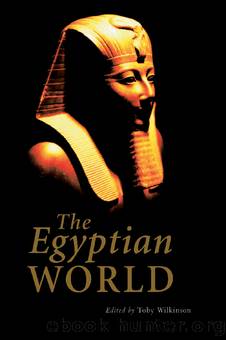
The Egyptian World by Wilkinson Toby A. H
Author:Wilkinson, Toby A. H.
Language: eng
Format: epub
ISBN: 978-1-136-75376-3
Publisher: Taylor & Francis Ltd
Figure 20.10 Amenhotep III venerates his own, deified, self in the temple at Soleb in Nubia. The deified king sports a nemes-headdress surmounted by a lunar disc and the ramâs horn of Amun, and is carrying the ankh and was-sceptre characteristic of deities (after Wildung, D. (1977) Egyptian Saints. Deification in Pharaonic Egypt, fig. 4, New York: New York University Press).
Certainly, there were differing positions. From the Middle Kingdom, following the uprooting of social values in the First Intermediate Period, there is evidence that admits to the mortality and fallibility of the king. At the same time, authors were able to compose (sometimes rather disrespectful) stories about the actual (that is, non-ritual) lives of kings, even if these were generally fictional. A particularly striking example is the Tale of King Neferkara (probably Pepi II of the 6th Dynasty) and his homosexual relationship with one of his generals, Sasenet (Parkinson 1997: 288â89). In the aftermath of the Amarna ârevolutionâ and later, during the rule of various foreign dynasties in Egypt, the Egyptian elite increasingly directed their attention and expectations to the gods, and away from the now conspicuously imperfect king, in a process that is mirrored in the diminished respect shown to the Egyptian king and court in neighbouring countries (Rössler-Köhler 1991; Baines 1995a: 33â42). The famous Tale of Wenamun (Lichtheim 1976: 224â30), set at the end of the 20th Dynasty, bears eloquent witness to the changed situation.
Formally, however, Egypt adhered to its time-honoured ideology of kingship until the end of pharaonic history, and beyond.
NOTES
1 There, reference is made to humans as the âliving imagesâ of the king, implying, in turn, his likeness with the gods according to the Egyptian belief that men are images of the creatorgod (e.g. Parkinson 1997: 206 M I.9). The largely anthropomorphic representations of Egyptian gods â if often sporting animal heads â underscore this outward similarity.
2 Potentially as early as Aha, to judge from an ivory label from the tomb of queen Neithhotep (the mother of Aha?). See, e.g., Spencer 1993: 63 fig. 42; discussion in Wilkinson 1999: 203â4.
Download
This site does not store any files on its server. We only index and link to content provided by other sites. Please contact the content providers to delete copyright contents if any and email us, we'll remove relevant links or contents immediately.
Hyperculture by Byung-Chul Han(631)
The European Opportunity by Felipe Fernández-Armesto(623)
Morgan Kaufmann Digital Watermarking and Steganography by Ingemar Cox Matthew Miller Jeffrey Bloom Jessica Fridrich Ton(615)
The European History Highway: A Guide to Internet Resources by Dennis A. Trinkle Scott A. Merriman(582)
The Seven Wonders of the Ancient World by Michael Denis Higgins(571)
European Security without the Soviet Union by Stuart Croft Phil Williams(549)
The Routledge companion to Christian ethics by D. Stephen Long Rebekah L. Miles(546)
European Security in a Global Context by Thierry Tardy(544)
Get Real with Storytime by Julie Dietzel-Glair & Marianne Crandall Follis(498)
Gorbachev And His Generals by William C. Green(483)
Hudud Al-'Alam 'The Regions of the World' - a Persian Geography 372 A.H. (982 AD) by V. V. Minorsky & C. E. Bosworth(480)
Inheriting Walter Benjamin by Gerhard Richter;(476)
Tibetan Studies in Comparative Perspective by Chih-yu Shih Yu-Wen Chen(471)
CliffsNotes on Fitzgerald's The Great Gatsby by Kate Maurer(465)
Governance, Growth and Global Leadership by Espen Moe(464)
The Master Builder by Henrik Ibsen--Delphi Classics (Illustrated) by Henrik Ibsen(460)
How Languages Are Learned 5th Edition by Patsy M Lightbown;Nina Spada; & Nina Spada(452)
The Oxford History of the World by Fernández-Armesto Felipe;(436)
The Oxford Handbook of the Incas by Sonia Alconini(422)
